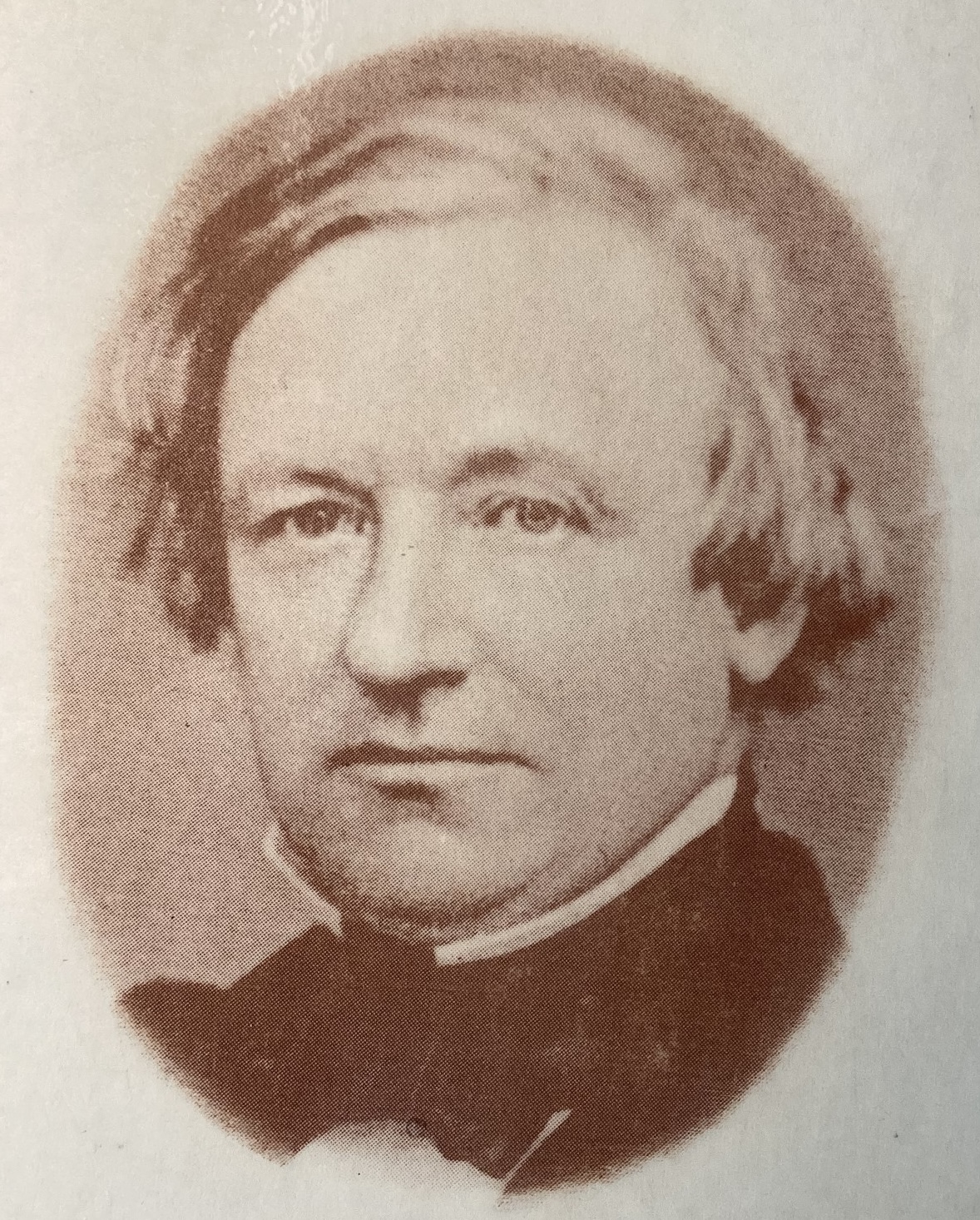
Scientist, statistician photographer, tale collector 1807-1887
Robert Hunt was born in Stoke Damerel, Plymouth on 6 September 1807. His mother, Honour, was from St Levan in the far West of Cornwall; his father, a ship’s carpenter, died before Hunt was born. Hunt lived in Plymouth as a child then moved to Penzance with his mother, where he attended Penzance Grammar School.
His heard folktales in is childhood, his Hayle aunt told him stories of the fairy folk, and on a visit to Lanhydrock with his mother when he was 10 he heard a story about a Devil in a Tower.
Two years later they were off to London, where Hunt was apprenticed to a surgeon. That didn’t work out, but Hunt was then apprenticed to the surgeon’s druggist brother, and he became a chemist, making and selling medicines.
Aged 20 he fell in the freezing River Thames, became chronically ill, toured Dartmoor and Cornwall on foot and walked himself well. He visited Lanhydrock but no one remembered the tale of the Devil in the Tower, so he resolved to collect vanishing droll tales on his journeys, to ‘visit each relic and gather every tale of its ancient people’.
After a spell working as a manufacturing chemist in London, Hunt returned to Penzance and set up shop as a pharmacist in his Uncle James’s saddlers workshop, doing a bit of scientific lecturing on the side. He made a cold cream containing wild thyme to heal dry, cracked skin, which was sold throughout Cornwall. He married Harriet in 1934, and stayed in Penzance till a family row in 1836 saw Hunt and his wife thrown penniless onto the streets.
They lived in Plymouth for a while, then in 1840 Hunt was appointed secretary of The Royal Cornwall Polytechnic Society in Falmouth.
He was fascinated by the study of light, and in the new science of photography - he wrote the first English language manual of photography, published in 1842.
In 1845 he was appointed Keeper of Mining Statistics at the new Museum of Economic Geology (Geological Museum) in London, a job he held for 38 years.
He was made fellow of the Royal Society in 1854, and of the Royal Statistical Society in 1855.
Though a top scientist he maintained his interest in folklore and continued his tale collection adding stories found and transcribed by friends and acquaintances: Thomas Couch for South East Cornwall, the Zennor postman, William Bottrell. He published Popular Romances of the West of England in 1865, a treasury of clear, concise retellings of Cornish tales, categorised by theme, easy to access even now.
Hunt died in London in 1887, a very important person. His rags to riches story could be a fairytale itself, and he showed that belief in science and wonder at magic can coexist.
Publications written by Hunt
Popular Treatise on the Art of Photography 1841
Researches on Light 1844
The Poetry of Science 1848
Catalogue for The Great Exhibition 1851
Guides to the ( new) Geological Museum1857
Popular Romances of the West of England 1865
British Mining 1884
About Hunt
‘Robert Hunt’ A R Pearson 1976 Federation of Old Cornwall Societies
‘Placing Early Photography: the work of Robert Hunt in Mid-Nineteenth Century Britain ‘ James R. Ryan. 2017
‘Cornish Legends’ Charlotte MacKenzie 2022
https://www.tandfonline.com/doi/full/10.1080/03087298.2017.1357268
https://www.cornwallheritage.com/ertach-kernow-blogs-2022-2023/cornish-folktales-and-stories-saved/
https://www.falmouthpacket.co.uk/news/15624683.photographic-pioneer-honoured-with-blue-plaque/