
Eating people is wrong
Some folkloric stories are drawn from sparse sources where we must reach for our imaginations to fill in some of the gaps. But some happened in the full light of a literary age and appear before us in glorious detail, the lack of doubt giving us nowhere to hide as we confront the narrative’s sharp edges.
This tale is one of those, though it takes some time to arrive into Cornwall. It begins in Southampton, where, in 1883 Tom Dudley, an experienced yachtsman, was hired to sail a racing yacht, the Mignonette, all the way to Sydney, Australia. In May 1884, the yacht finally left Southampton, sailed by four men: the captain, Tom Dudley; two seasoned seamen, Edwin Stephens and Edmund Brooks; and a cabin boy, Richard Parker — an orphan, seventeen years old and without blue water sailing experience. The untested Parker was enthused about the expedition despite the concerns of his loved ones, and Captain Dudley promised to make it worth his while, offering to teach him how to read and write on the way.
It didn’t take long before a great crisis overcame them; in the Atlantic a storm whipped up and sank the Mignonette. They were forced to escape into their dingy, taking with them scant supplies: two tins of parsnips was their only source of sustenance. They found that no rescue was forthcoming and after two weeks were clearly nearing their end. It was at this time that Richard Parker drank a large quantity of seawater in a desperate attempt to meet his thirst. This was a death sentence for an already dehydrated body, of course, and as the days passed he slipped into something like a coma. After a lengthy discussion, Dudley and Stephens agreed that they should turn to the custom of the sea. One should die, so that the others may live. Brooks abstained from the decision but did not protest as Stephens held down the boy’s legs and Dudley used his penknife to sever the jugular vein. They caught the blood in the case of their chronometer, and then worked to butcher the body.
This was of course not the first incident of maritime cannibalism. The custom of the sea had long been known by those that sailed open water, and there are many examples across the centuries of sailors calling upon it amidst desperate situations. The custom was meant to refer to an egalitarian lottery — all take lots and the loser accepts their sacrifice — but men often preferred to murder a weaker or more expendable individual than risk their own death.
The death of Richard Parker almost certainly saved the lives of his crew-mates. On the 29th July, four days after Parker’s death and twenty-four days after the sinking of the Mignonette, a sail was sighted. The vessel was a German ship, the Montezuma, which, fortunately, spotted the dinghy and picked up the three survivors. They were nursed over the following weeks, their sores receding and their bodies strengthening, and on the 6th September were dropped off in Falmouth.
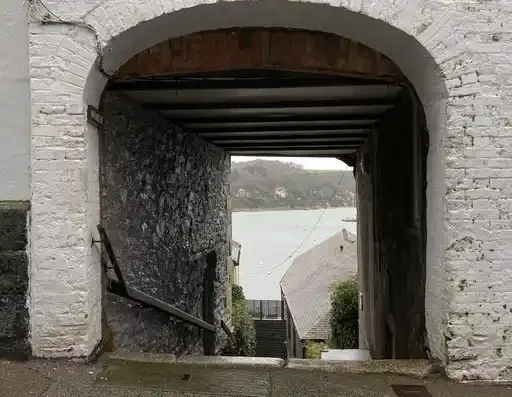
They landed at Barracks Quay, still at the bottom of Barracks Ope today, but found that a crowd of curious onlookers were awaiting them. The pilot who had brought the Montezuma into Falmouth’s harbour had met the unfortunate men and, after disembarking, had spread their story through the town. The surely overwhelmed men were taken to the town’s custom house where they gave a statement about what happened. It was an entirely honest account of everything for they had no fear of any legal consequences; it was the custom of sea, and surely no one could blame them for that? And yet, a harbour policeman present, Sgt Laverty, did not see it the same way. That evening they were arrested and jailed below the police station, now the card factory shop on Market Street.
The accused appeared before magistrates in Falmouth’s courthouse, a building now known as the Old Town Hall Gallery on High Street. There were a couple of notable surprises awaiting them. Firstly, Daniel Parker, eldest brother of the deceased, attended proceedings and publicly shook hands with the men as a demonstration of understanding and support. And then, even more shockingly, the charges against Edmund Brooks were dropped, and he stood instead as a witness for the prosecution. He may have eaten Parker’s flesh, but he had not slit his throat, and now found that he was able to step out of the legal firing line.
A further trial was held in Exeter, and then in London. They were strange affairs from a legal perspective, and they occurred, as high-profile trials generally do, within a whirlwind of media focus and popular interest. For every newspaper columnist that voiced their support, there was another who saw Dudley and Stephens through a far harsher lens. In the end it was the latter group who would be satisfied with the outcome: the two men were convicted of murder and sentenced to death, though this was shifted to six months in prison without hard labour due to public pressure.
The story of the men’s ordeal and the trials that followed became fodder for a Victorian public fascinated with the macabre — the dinghy itself ending up exhibited (with additional bloodstains) for paying audiences, and Edmund Brooks took employment in a travelling sideshow, dressing in rags and eating scraps of raw meat. It was a media sensation that rippled around the world, but at the heart of the narrative lay the streets of Cornwall’s great harbour town, Falmouth.
- A gruesome true tale reported in local newspapers
- West Briton and Cornwall Advertiser (8th September 1884)
- The Cornish Telegraph (18th September 1884)
- Royal Cornwall Gazette - (12th September 1884)
- Royal Cornwall Gazette - (19th September 1884